Monday, April 6, 2009

Yeast Experiments, Part 1


Yeast Week - Home Brewing

We have been doing a few yeast experiments this week, some of which are still in the process of being completed. The major part of this week was making our own root beer, which will be covered in another post. Here we have two small experiments that we did as well.


Testing Yeast Experiment.

Before we tried the root beer experiments, we found that the yeast we were going to use (it was champagne yeast from a kit) had expired in 2006, so the first thing we did was to test to see if it was still good with this experiment.

Materials:
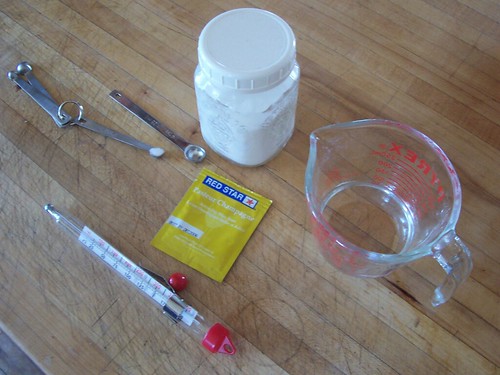

Small glass measuring cup
Candy thermometer
Measuring spoons
Water
1 package Champagne yeast (1 package yeast = 2 1/4 teaspoons)
Sugar

1. Pour 1/4 cup water into a small glass measuring cup for liquids. Heat in microwave 20 seconds on high. Stir. Measure temperature. Water should be between 100 and 105 degrees F. If too cool, heat for 10 seconds. If too hot, add some cool water.

2. Add ½ teaspoon yeast and a pinch of sugar. Stir and let sit for 5 to 10 minutes, until the sugar and yeast dissolve. If a foamy layer forms on the surface, the yeast is still active.

3. If still active, seal the package and put in refrigerator for later. If not, throw it out.

The result was that the champagne yeast was too old to be used. We tested this along with regular baker's yeast and decided to use that instead.
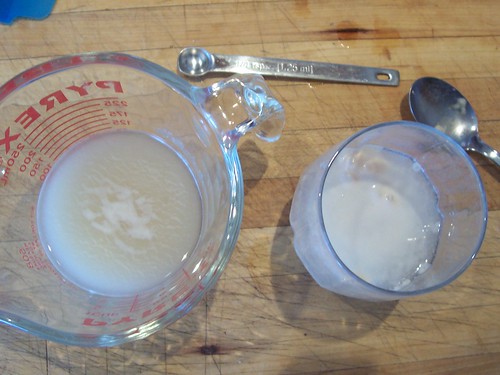
Champagne yeast on the left, baker's on the right.

Watching yeast ferment

This experiment was just for fun. It has a neat effect which was very cool to see.

Materials:


2 empty soda bottles, washed no tops
2 latex balloons
2 rubber bands
glass measuring cup, 1-cup capacity
measuring spoons
clock
flour
sugar
water, room temperature
yeast

1. In each bottle put 2 teaspoons yeast, 1 teaspoon sugar and 1 cup water.

2. In one soda bottle, add 2 tablespoons flour. Mark this bottle.

3. Secure a balloon on top of each soda bottle with a rubber band.
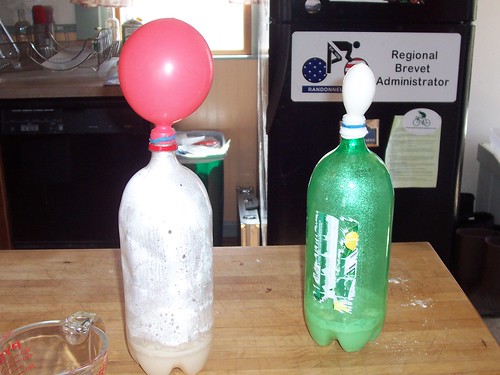


The balloon on the left is the one without flour, the green one has the flour in it.

Links
-FoodSub - Yeast Types: http://www.foodsubs.com/LeavenYeast.html
-Red Star Brand Yeast: http://www.lesaffreyeastcorp.com/SoY/story_2.html

Sunday, April 5, 2009

Biology Online

Here's a site I found today when I needed information on photosynthesis for a book I'm working on:

Biology Online is the number one website for biology content and information on the web. The site aims to educate and promote awareness of all things biology, offering free and easy access to information in the biological sciences.

Created in 2001, the site provides a wealth of information in the diverse field of biology offering a forum for discussion, an editable-dictionary with thousands of terms, links to external resources, tutorials, articles and a biology book catalogue with user reviews.

Sunday, March 29, 2009

Hey Homeschoolers! I Need Your Help...

A commenter over at GeekDad (where I am now one of two homeschooling mom contributors!) wanted to know if there were any geeky (science and tech oriented) homeschooling blogs. What are your favorites? Please comment!

Thursday, March 19, 2009

Taxidermy at the Pember Museum


I've got a post up at GeekDad today about our trip earlier this week to the Pember Museum of Natural History in Granville, NY. It's a tiny one-room exhibit atop the public library, but I thought of its taxidermy collection when we were doing all that Darwin stuff. Links and more details at GeekDad.

Wednesday, March 18, 2009

Growing Fungi, Part 2


We researched some more questions about mushrooms:

#1 – How long can a mushroom live?
Source- Australian National Botanic Gardens, Wikipedia.com


The mushroom has a lifespan ranging from a few days, to hundreds of years. The lifespan depends heavily on how many neighboring mushrooms there are, the more neighbors, the longer the mushrooms live. The log that we bought says that the Shiitake mushrooms can last up to 4 years.

#2 – What are the symptoms of being poisoned by a mushroom?
Source-Wikipedia.com

Poisonous mushrooms contain a variety of different toxins that can differ markedly in toxicity. Symptoms of mushroom poisoning may vary from gastric upset to life-threatening organ failure resulting in death. Serious symptoms do not always occur immediately after eating; often not until the toxin attacks the kidney or liver, sometimes days or weeks later.
The most common consequence of mushroom poisoning is simply gastric upset. Most "poisonous" mushrooms contain gastrointestinal irritants which cause vomiting and diarrhea (sometimes requiring hospitalization), but no long-term damage. However, there are a number of recognized mushroom toxins with specific, and sometimes deadly, effects.

#3 – How many types of mushrooms are poisonous?

Wikipedia.com

Of the many thousands of mushroom species in the world, only 32 have been associated with fatalities, and an additional 52 have been identified as containing significant toxins.

Tuesday, March 17, 2009

Disney Hydroponics

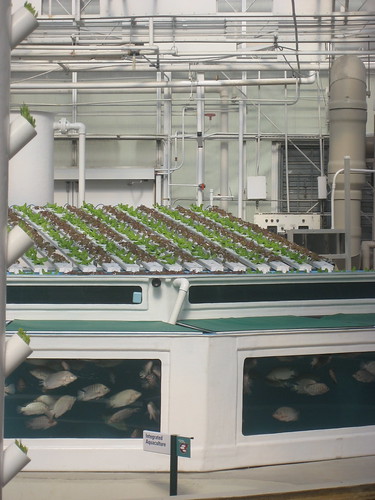
This picture of hydroponic veggies in a fish tank is from the Homeschooled Twins blog. The family took a behind the scenes tour of a ride at Disney World in Florida called Living with the Land. Looks like a lot of fun!

Monday, March 16, 2009

Growing Fungi


A couple weeks ago, for biology, we sent away for a Shiitake-mushroom-growing kit. We have since grown (and eaten) a cluster of mushrooms. Some Q&A about mushrooms:

How can I tell which wild mushrooms are poisonous?

Contrary to popular belief, there is really no discerning characteristic that all poisonous mushrooms share. Since only about 5% of wild mushrooms are edible, I wouldn’t recommend eating a wild mushroom unless you are a hundred percent sure that it isn’t poisonous.

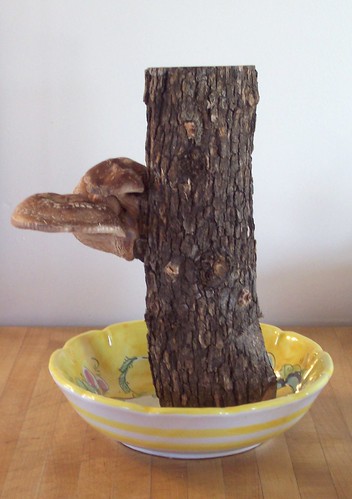
The log with the fully-grown mushrooms.

What is the life cycle of a mushroom?

(From ArticleClick.com)
Most mushrooms reproduce asexually by releasing thousands of spores through their gills into the open air for dispersion into the environment. Every spore is capable of germinating to create a new hypha. Hyphae are masses of intertwined filaments of cells which are the morphological unit of the fungus. When a thick mass of hyphae forms it is called mycelium or mycelia. Mushroom mycelium is usually white in color with a rough, cottony texture. Root like growth is called rhizomorphic.

When spores germinate they consume the water and nutrients from their environment and begin to reproduce. The medium that mushroom mycelium grows on is usually called substrate. Before the mushroom can start to form fruit bodies the mycelium colonizes the substrate fully and when the environmental conditions are right the mushroom emerges to produce more spores.

The mushrooms after we harvested them.

What different kinds of mushrooms are native to what areas?

Probably the most common edible mushroom, the Button Mushroom, is native to Europe (and North America.) The Portobello is also native to Europe and North America. The Shiitake is native to East Asia. The deadly Death Cap is native to Europe, North Africa, North America, Australia (SE), and New Zealand.

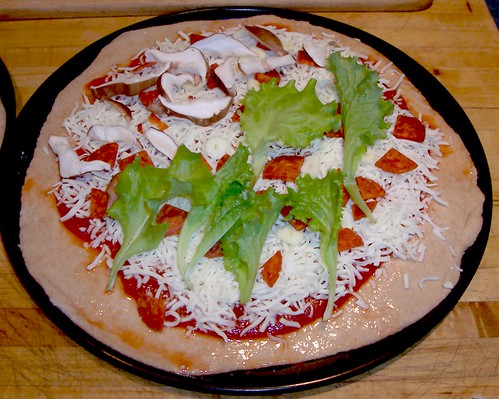
A delicious Shiitake-mushroom-and-lettuce pizza.

Mushroom Links:

Mushroom Life Cycle
Cornell University Virtual Library: Mycology
Lost Creek Mushroom Farm (supplier)
Fungi Perfecti (supplier)
Diagram of the mushroom life cycle.